

Source review: Checked on 14 August 2026 against FCA, ESMA, CFTC and NFA materials on order execution, pricing, slippage and retail forex controls. Legal duties vary by jurisdiction and product; this guide explains what a retail user can verify rather than assuming one global execution rule.
Quick answer: After you click Buy or Sell, your order still has to reach the broker, pass its price and order-handling rules, and receive a result. It may be filled at the requested price, filled at a better or worse price, requoted, partially filled or rejected. The broker’s execution policy should explain when each outcome can occur and what evidence is recorded.
Most trading screens make an order look instant: click, confirmation, position opened. The process behind that screen is more important than it appears. A few milliseconds of transmission, a changing quote, limited liquidity or an internal rule can change the final price—or prevent the order from being filled at all.
This does not mean every price difference is manipulation. Markets move and connections take time. The real question is whether the broker’s method is disclosed, consistently applied and supported by records you can examine.
What happens after you click Buy or Sell?
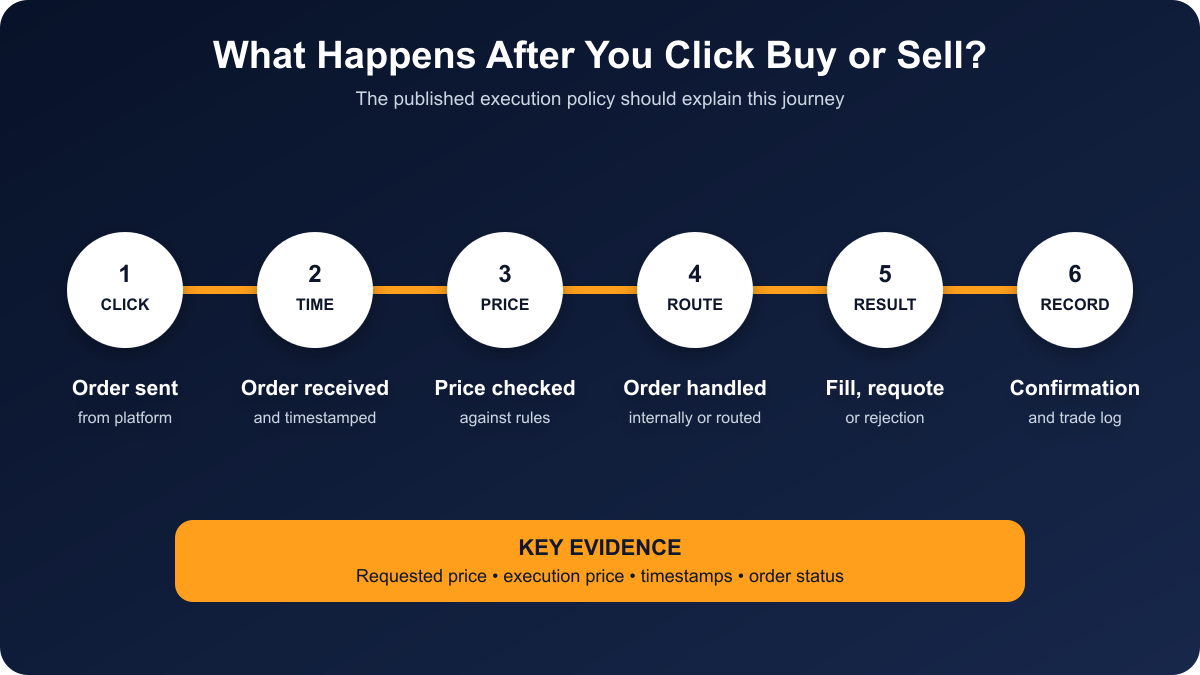
A simplified retail forex or CFD order journey has six stages:
- You submit an instruction. The platform records the instrument, size, direction and order type.
- The order reaches the broker. The broker’s system receives and timestamps it.
- The current price is checked. The displayed quote may have changed during transmission.
- The order is handled. Depending on the model, the broker may execute internally, hedge the exposure or route an order to another venue or liquidity provider.
- An outcome is produced. The order may be filled, price-improved, negatively slipped, requoted, partially filled or rejected.
- The result is recorded. A trade confirmation or rejection notice should preserve the essential details.
Execution is not the same as regulation
Confirming that a broker is regulated is essential, but regulation alone does not tell you how a particular order will be handled. First identify the exact contracting company with our forex broker legal-entity check. Then read the execution policy issued by that same entity.
Do not assume that a policy from the broker’s UK or EU company applies to an offshore affiliate with a similar website. Client agreements, regulators, execution venues and complaint rights can differ. Our comparison of regulated and offshore forex brokers explains why the entity matters.
What is slippage?
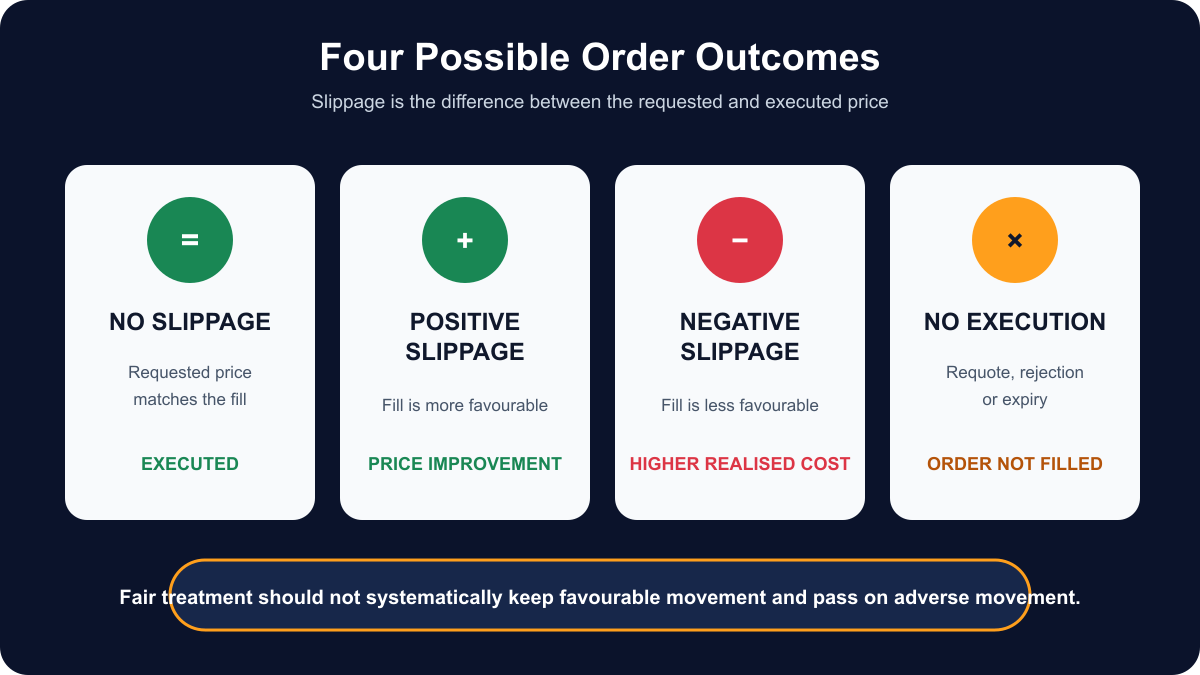
Slippage is the difference between the price requested or displayed when an order is submitted and the price at which it is executed. It can be:
- Zero: the requested and executed prices match.
- Positive: the execution price is more favourable to the client.
- Negative: the execution price is less favourable to the client.
Slippage can arise for legitimate reasons, including fast market movement, limited available volume, network delay and the time required to process the order. It is not automatically proof of unfair conduct.
However, direction matters. NFA guidance says slippage settings and requoting practices should not systematically favour the dealer. FCA and CFTC materials have also described cases where firms passed adverse movements to clients while retaining favourable movements. That pattern is commonly called asymmetric slippage.
What is a requote?
A requote occurs when the original displayed price is no longer available and the broker offers a new price for the user to accept or reject. Requotes are more closely associated with some “instant execution” arrangements than with pure market execution, but broker terminology is not standard enough to rely on the label alone.
A good policy should answer:
- Which order types can receive a requote?
- How much can the price move before a requote is triggered?
- How long does the new quote remain available?
- Are the same rules applied when the market moves in the client’s favour?
- What happens if the user does not respond?
A requote is different from negative slippage: a negatively slipped market order is already executed at a less favourable price, while a requote normally asks the client to make a new decision.
Why can a forex order be rejected?
An order can fail for several reasons: the requested price is no longer available, market trading is paused, the order violates minimum-distance rules, available margin is insufficient, the product is restricted, the submitted volume exceeds available limits, or the platform loses its connection.
The existence of an order rejection is not by itself evidence of wrongdoing. Repeated or selective rejection deserves closer examination—especially when favourable client orders fail more often than comparable adverse orders.
Save the rejection message, exact time, instrument, order type, requested price and a screenshot. A complaint based on evidence is stronger than “the platform did not work.”
Market, limit and stop orders do not promise the same result
Market order
A market order prioritises execution over a guaranteed price. It asks to trade at the best available price under the broker’s method. The price visible at the moment of the click is not necessarily a promise.
Limit order
A limit order sets a price boundary. It generally should not be filled at a worse price than the limit, but execution is not guaranteed. The policy should explain price improvement, partial fills and what happens when available volume is insufficient.
Stop order
A stop order becomes active when its trigger condition is reached. After activation, it may operate like a market order and therefore be exposed to gaps or slippage—unless the broker separately offers a guaranteed stop with its own terms and possible premium. If a gap pushes the account below zero, use our negative-balance protection check for UK, Cyprus and offshore accounts to identify which rule or contract may apply.
Read the exact definitions in the client agreement. Our guide to forex broker agreement clauses shows where order terms, pricing discretion and platform failure language may appear.
Does STP, ECN or “no dealing desk” guarantee better execution?
No marketing label guarantees a particular outcome. ESMA’s CFD guidance describes different arrangements: a firm may act as the client’s execution venue, hedge client exposure on a back-to-back basis using straight-through processing, or send orders to third-party venues. More than one model can exist within the same firm.
The useful questions are concrete:
- Who is the client’s contractual counterparty?
- Who determines the client’s execution price?
- Which external price sources or venues are used?
- Does the broker add a spread or markup?
- Can favourable price improvement reach the client?
- When can an order be rejected, delayed or partially filled?
A broker can use STP technology and still apply a markup. A market maker can hedge some client exposure. The label is not a substitute for the execution policy and transaction records.
Five questions to ask about an execution policy
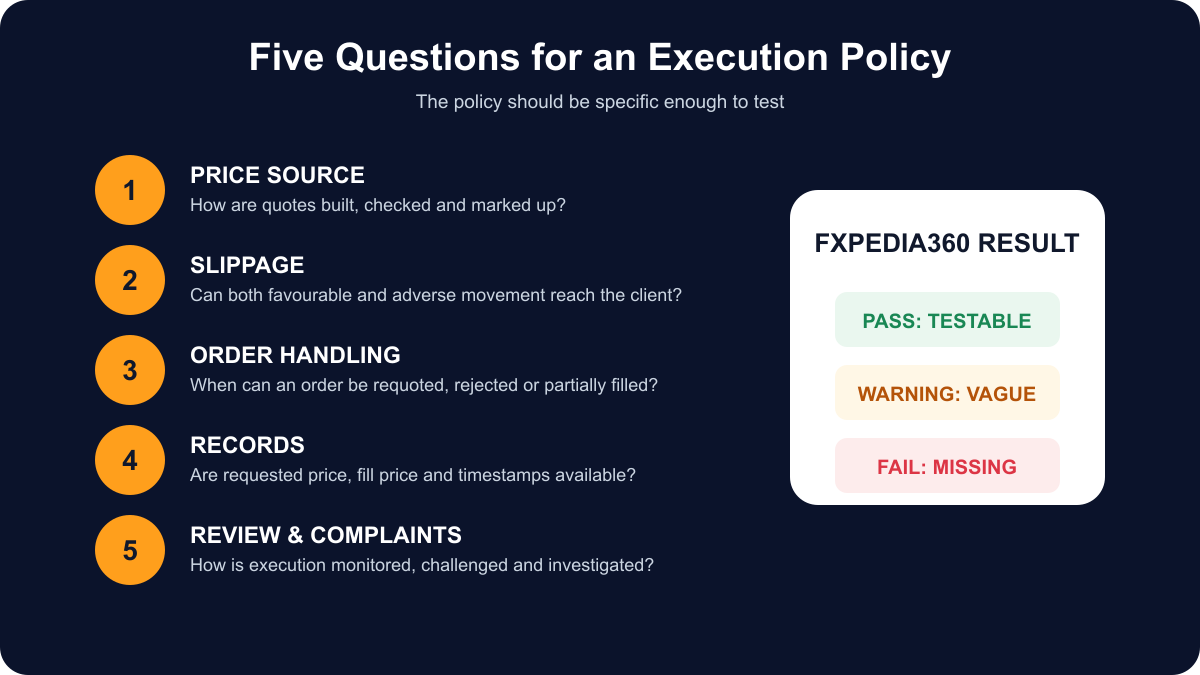
1. Where do the prices come from?
The policy should explain the price sources, how the broker builds its quotes and whether a spread or markup is added. “Market price” without a source or method is not very testable.
2. How is slippage treated?
Look for both positive and negative slippage. A policy that explains only adverse movements leaves an important question unanswered.
3. When can the broker requote, reject or partially fill?
The conditions should be specific enough to compare with an actual trade. Vague language giving unlimited discretion deserves a warning.
4. What records can the client obtain?
Requested price, execution price, order type, volume, status and timestamps help reconstruct what happened. Screenshots are useful, but broker-side records are usually more important.
5. How is execution monitored and challenged?
Check whether the broker reviews execution quality, identifies exceptions and provides a formal complaint process. Also verify the relevant regulator or ombudsman route for the exact entity.
The FXPEDIA360 execution-policy result
PASS: The legal entity matches, price sources and order rules are described, favourable and adverse slippage are addressed, and the policy can be tested against transaction records.
WARNING: The policy exists but relies on generic terms, unexplained discretion or marketing labels such as ECN, STP or “no dealing desk.”
FAIL: The policy is missing, belongs to another legal entity, contradicts the agreement, or available records indicate systematically asymmetric treatment.
A pass is not a guarantee that every order will receive the best imaginable price. ESMA explains that best-execution arrangements are assessed as a process designed to obtain the best possible result consistently—not as a promise that every individual trade will be optimal.
How to test execution without risking more money
- Download the current execution policy and record the date.
- Use a demo account first to understand order types and confirmations.
- Do not assume demo and live execution are identical; check the disclosure.
- If you later trade live, keep position size small enough for your risk rules.
- Record requested price, fill price, timestamps and market conditions for a sample of orders.
- Count positive and negative slippage separately.
- Compare your observations with the published policy before making a complaint or conclusion.
Execution difference is part of the all-in trading cost. Use the companion guide, Forex Broker Fees: 10 Costs New Traders Often Miss, to combine it with spreads, commissions, funding and conversion charges.
Frequently asked questions
Does slippage always mean the broker manipulated the price?
No. Slippage can result from genuine price movement, latency or limited liquidity. The concern is an unexplained or systematic pattern that conflicts with the policy or treats favourable and adverse movements asymmetrically.
Can positive slippage happen?
Yes. A changing market can create a more favourable available price. Whether and how that improvement is passed to the client should be explained in the broker’s policy.
Is a rejected order the same as a requote?
No. A rejection ends the submitted order without a fill. A requote offers a new price and normally requires the client to accept or reject it.
Does “market execution” mean the displayed price is guaranteed?
No. It generally prioritises obtaining a fill at an available price. Read the broker’s definition and slippage controls rather than relying on the label.
Official sources
- FCA: Best execution and payment for order flow
- ESMA: Best-execution obligations and sufficient steps
- ESMA/FCA Handbook: CFDs and speculative products Q&A
- NFA: Price slippage and requoting practices
- CFTC: Enforcement action concerning asymmetric slippage
Educational information only. This article is not investment, legal or personalised financial advice. Forex and CFD trading involves substantial risk. Verify the contracting entity, execution policy and complaint rights directly with the relevant provider and regulator.
Continue with the complete Broker Safety guide collection.
Execution evidence table
| Evidence to record | Where to verify it | Why it matters |
|---|---|---|
| Execution model and venue | Order-execution policy | Explains where and how orders may be handled |
| Slippage and rejection wording | Client agreement and execution policy | Sets the contractual rules for fills and rejections |
| Timestamped order record | Platform history and broker statement | Creates evidence for a later query or complaint |