

Evidence review: Official NFA, CFTC, SEC, FINRA, USAGov and IOSCO resources were checked on 14 September 2026. Complaint channels, regulatory records and eligibility rules can change, so repeat the relevant official check before filing.
Quick answer
Start with the exact legal entity in your agreement and account statement. Then follow four checks in order:
- Preserve the transaction record.
- Complain to the firm in writing.
- Check the complete NFA BASIC profile.
- Choose the route that matches the entity and product.
NFA, CFTC, SEC and FINRA do not cover the same firms or disputes. An NFA ID alone does not prove current membership.
A broker brand can route customers through different companies. The company shown on a website, the company in your client agreement, and the beneficiary on a deposit instruction may not be the same. Resolve that identity before you decide where to send a complaint.
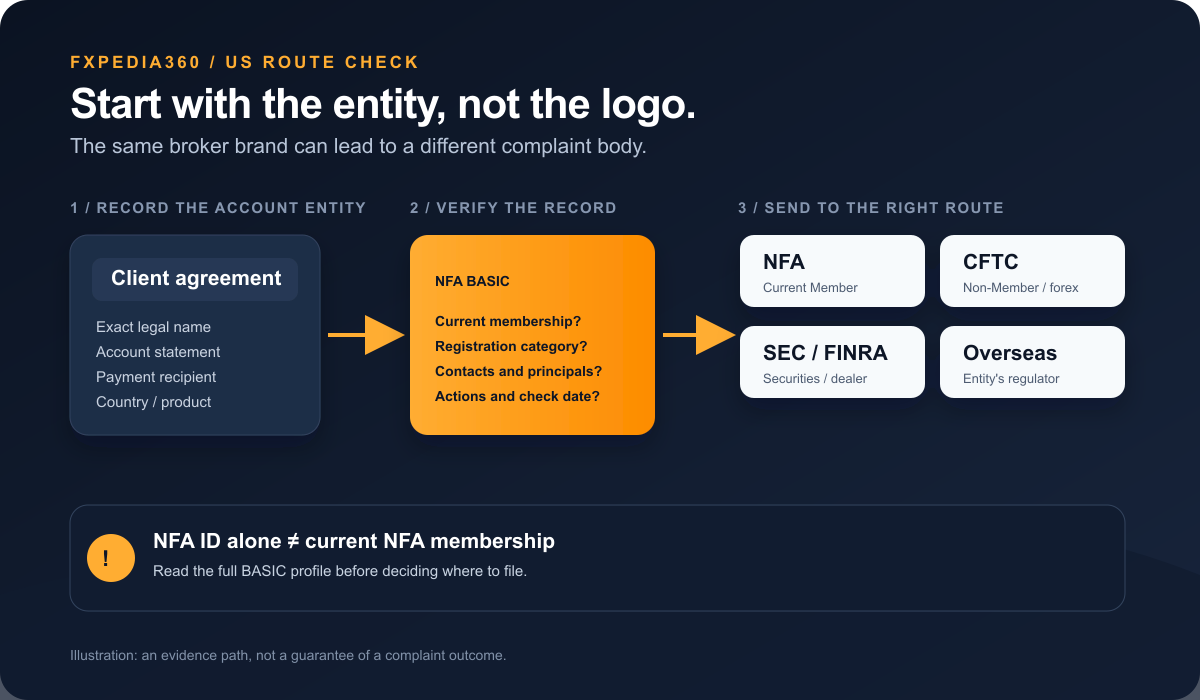
Why the legal entity decides the complaint route
The name customers remember is usually a brand. A complaint body needs the company that provided the service, held the account, or appeared on the transaction record. Record the full legal name, legal suffix, address, website domain, NFA ID if shown, and the country or state connected with the account.
Residence also matters. A person living in the United States may be offered a US entity, while a Turkish or European resident may be offered a company in another jurisdiction under the same brand. Do not use nationality, a US flag on a website, or a group-company licence as a substitute for the agreement you accepted.
Before escalating, run the legal-entity verification checklist. If the payment recipient differs from the agreement, record the mismatch and pause further transfers while you clarify it through an independently verified channel.
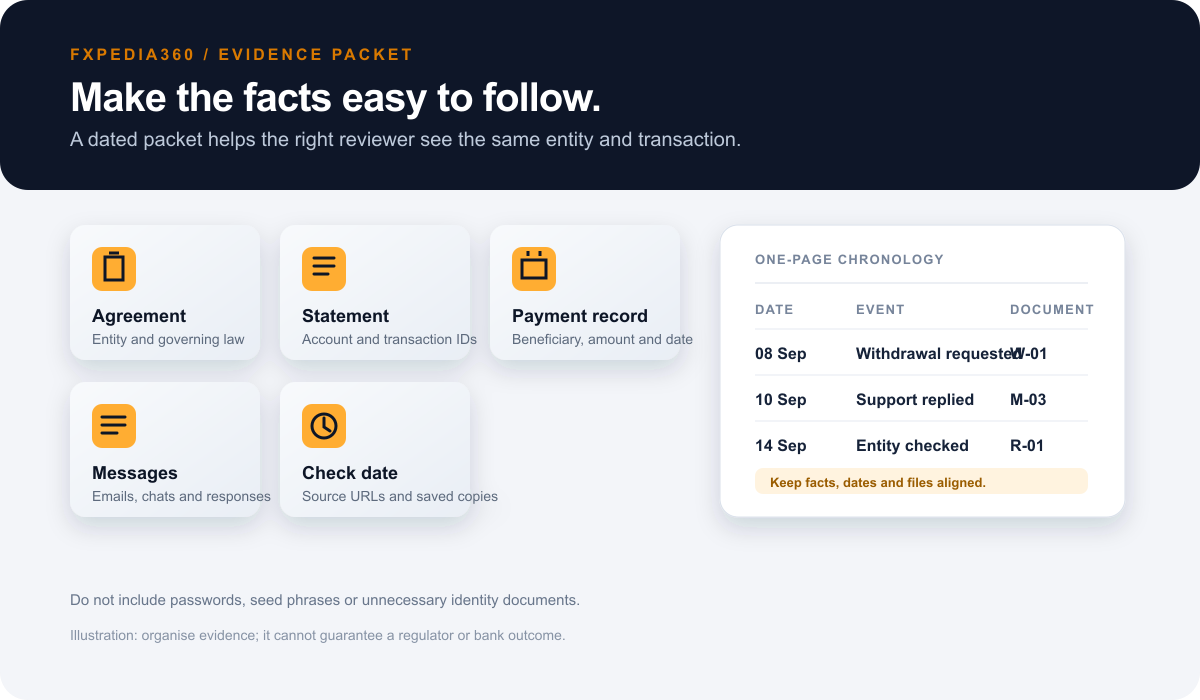
Before you file: build a dated evidence packet
A complaint is easier to review when another person can follow the facts without searching through a long message history. Create one folder and one chronology. Keep original files, and label copies with the date you saved them.
- the client agreement, account-opening disclosures and governing-law page;
- the exact legal entity, NFA ID, registration category and official profile URL;
- account statements, order or transaction records and withdrawal requests;
- deposit and withdrawal dates, amounts, currency, transaction IDs and payment recipient;
- emails, support tickets, chats and the broker’s written responses;
- screenshots that show the website domain, account portal and relevant terms; and
- a short chronology: date → event → document → response → unresolved point.
Do not send passwords, seed phrases or unnecessary identity documents to a new contact. If a person asks for another deposit, a “release” fee or an advance payment to recover funds, treat that as a separate warning sign. Our withdrawal red flags guide explains why those requests need a pause.
Step 1: complain to the broker in writing
Use the compliance or complaints address published in the verified firm record or client agreement. A salesperson’s private chat account is not a reliable complaint channel. Keep the message factual and ask for a specific response.
A useful subject line is Formal complaint — [account/entity] — [short issue]. In the body, include:
- your name, account reference and the exact company;
- the dates and amounts involved;
- what happened, in chronological order;
- the documents attached or linked by filename;
- the action you want the firm to take; and
- your requested response date and the best contact channel.
Save the sent message, attachments and confirmation number. This step creates a record of notice; it does not decide jurisdiction or guarantee a refund. The broker agreement clause guide can help you find complaint wording, governing law and notice requirements.
Step 2: check the complete NFA BASIC profile
Open NFA BASIC directly from the NFA website. Search the exact legal name and then the NFA ID separately if one is available. Compare the spelling, suffix, address, website and listed principals with your account documents.
Read the current membership or registration status, the relevant category and forex designation, regulatory actions, disciplinary history and principal profiles. NFA explains that an NFA ID can exist for a former Member, a pending applicant or a non-Member that has an ID for tracking. The ID by itself is not proof of current NFA membership or oversight.
Write down the status and the date you checked it. If the firm is not found, or if the profile does not match the entity that took your money, keep the result as evidence and move to the route that fits the facts. Do not label the absence of a record as a legal finding by itself.
For the click-by-click process, see How to Check a Forex Broker on NFA BASIC.
Step 3: choose the route that matches the evidence
The table below is a routing aid. It does not replace the agency’s own instructions or a legal assessment.
Current NFA Member
Start with: the NFA complaint page for a forex, futures or swaps issue within its scope.
Limit: Current membership does not prove jurisdiction over a non-Member or promise payment.
Non-Member or suspected unregistered solicitation
Start with: the CFTC complaint or tip route when the conduct may fall within the CFTC’s remit.
Limit: A submission does not ensure agency action or Reparations eligibility.
Potential CFTC Reparations claim
Start with: current CFTC Reparations information when the respondent was a qualifying registered professional and the claim concerns a covered futures-industry violation.
Limit: It is not a universal refund process.
Securities account or broker-dealer
Start with: the SEC or FINRA, after writing to the firm when appropriate.
Limit: These routes do not cover every retail OTC-forex dispute.
Agreement names an overseas entity
Start with: the responsible national regulator. The IOSCO member directory can help identify an authority.
Limit: IOSCO membership does not prove jurisdiction, compensation or a remedy.
Card, bank or payment-provider issue
Start with: the bank or payment provider promptly, while keeping that dispute separate from the broker complaint.
Limit: A payment dispute is not guaranteed and does not determine the broker’s regulatory status.
NFA Member: use the NFA process when the profile fits
NFA’s complaint page is aimed at complaints about NFA Members and their business practices. Confirm the current status and history first. If the firm only has an NFA ID but is not a current Member, NFA says it does not have jurisdiction over that non-Member. Sending the file to NFA anyway can delay the route that fits your facts.
Non-Member or suspected unregistered solicitation: consider the CFTC route
The CFTC accepts tips and complaints about possible violations and explains a separate Reparations program for certain customer claims against futures-industry professionals registered at the relevant time. Select the channel that matches your purpose. A normal customer complaint is different from a whistleblower submission, and neither is a promise of recovery.
If a foreign company solicited you while you were in the United States, the CFTC’s consumer guidance says foreign entities are generally required to register for activities covered by its rules, although exemptions can exist. Treat that as a prompt to verify the facts, not as a conclusion about a particular firm.
Securities-related issue: do not use the forex route by habit
Some disputes involve a securities account, a broker-dealer or an employee rather than a retail OTC forex dealer. NFA directs securities-related complaints to the SEC and complaints involving US broker-dealers and their employees to FINRA. FINRA advises investors to contact the firm and complain in writing first; it may forward an out-of-scope issue, which can add delay.
Overseas entity: follow the company in the agreement
If your documents name a Cyprus, UK or other overseas company, repeat the entity check for that company. The US route is not automatically the right route because the brand advertises to US readers. For a Cyprus or EU account, use the CySEC verification guide and the national authority named in the agreement.
What to send with the complaint
Lead with the facts another reviewer needs to identify the firm and transaction:
- Identity: brand, exact legal entity, address, domain, NFA ID and account reference.
- Chronology: a dated list of deposits, trades, withdrawal requests and responses.
- Issue: one clear description of the conduct you want reviewed.
- Amount: currency, amount and how you calculated the outstanding balance.
- Evidence index: filenames for agreements, statements, payment records and messages.
- Prior contact: when you complained to the firm and what it answered.
- Requested action: the review, explanation or correction you are asking for.
Use neutral language such as “the record shows” and “I have not received.” Do not turn an unresolved mismatch into an accusation you cannot support. A regulator can assess the information you submit; it cannot replace a court or give personal legal advice.
What each route can and cannot do
Regulators and dispute bodies have different mandates. A submission may help an agency identify patterns or assess conduct, but it does not guarantee that your account balance will be restored.
- NFA: can receive complaints involving its Members and provides BASIC information; it does not have jurisdiction over non-Members.
- CFTC: can receive tips and complaints about matters within its remit and describes a Reparations process for qualifying claims; it does not guarantee a refund.
- SEC/FINRA: address certain securities and broker-dealer matters; they are not a universal OTC-forex complaint channel.
- Overseas regulator: may be the correct authority for the entity in your agreement; powers, eligibility and deadlines vary.
- Bank or card provider: may review a payment dispute under its own rules and deadlines; it does not determine whether a broker was authorised.
Watch for recovery scams after you complain

A blocked withdrawal can attract a second scam. Someone may claim to be a regulator, lawyer or recovery specialist and ask for a tax, insurance, validation or release payment. Verify every contact through the agency’s official domain. Do not give a new caller remote access to your device or send more money to unlock a previous balance.
Keep the original complaint process separate from paid recovery offers. If the account entity or payment recipient is still unclear, use the payment-recipient check before you contact another intermediary.
Frequently asked questions
Does NFA have jurisdiction over a non-Member?
NFA’s complaint page says it does not. Check the full BASIC profile, including current status and history, before using the NFA route. An NFA ID alone is not proof of membership.
Should I file with NFA or CFTC for a forex withdrawal dispute?
Identify the entity and current NFA status first. For a current NFA Member and an issue within NFA’s scope, start with NFA’s process. For a non-Member or a possible CFTC-covered violation, review the CFTC complaint or tip route. The agency pages control the final eligibility decision.
Can I use FINRA for every forex complaint?
No. FINRA is a securities-industry regulator and points its complaint process at broker-dealers and their employees. A retail OTC forex matter may belong with NFA, CFTC or an overseas authority depending on the entity and product.
What if the broker is offshore but solicited me in the US?
Save the solicitation, agreement, payment record and website domain. Check the entity and CFTC guidance, then consider the appropriate US or overseas authority. Do not assume that the brand’s location or absence from BASIC settles the legal question.
Will filing a complaint guarantee a refund?
No. A complaint creates a record and may help an agency assess conduct. It does not guarantee a withdrawal, compensation, chargeback, or legal outcome.
What if the payment recipient differs from the agreement?
Pause further transfers, save the instruction and transaction record, and ask the firm to explain the relationship through a verified channel. Treat an unresolved beneficiary mismatch as an evidence issue before choosing an escalation route.
Use the route finder after you identify the entity
Record the legal entity, product, country and NFA status first. Then use the Broker Complaint & Protection Route Finder to organise the next route. You can also use Broker Entity Lookup to compare the entity details you found. These tools organise public information; they do not provide legal advice or promise a result.
Official sources
- NFA: File a Complaint or Report Suspicious Business Practices
- NFA BASIC search
- CFTC: Be Smart, Check Registration and Backgrounds
- CFTC: Submit a Tip or Complaint
- SEC: Report a Problem with an Investment Account or Financial Professional
- FINRA: File a Complaint
- USAGov: Bank, Credit, and Securities Complaints
- IOSCO member directory
Evidence review: 14 September 2026. This article is general educational information, not financial, investment, legal or tax advice. Regulatory records, procedures, deadlines and protection arrangements can change. Verify the exact entity and current official route before filing or transferring money.