

US residents · Before you deposit
Start with the company in your account agreement. Then check its US record, your eligibility and where your money would go.
An offshore forex broker may accept a US address in its application form. That does not settle whether the company can offer you the account.
The CFTC says foreign entities that solicit people living in the United States to trade generally need CFTC registration, though some non-US firms are exempt. An overseas licence alone does not answer the US question. The account company, activity and applicable exception still need to be established. Read the CFTC’s registration guidance.
This guide is for US residents considering retail, off-exchange forex. Exchange-traded futures, ordinary currency conversion and institutional accounts can follow different rules.
Check 01
Find the company that would hold your account
Open the proposed client agreement and risk disclosure before you fund anything. Write down the full legal name of the company you would contract with, including any company suffix. Keep the agreement’s date or version and the website address.
A group’s homepage may describe several companies under one brand. A licence belonging to one group company cannot establish the status of a different company named in your agreement. Our guide to broker entities by country explains how those assignments can differ.
- Contracting company
- Full legal name
- Account offer
- Product + US residence
- Record to retain
- URL + document version + date
If the agreement is unavailable, or support gives you only a brand name, the first check remains unresolved. Ask for the document that would govern your account.
Check 02
Read the current US record for that exact company
Search NFA BASIC using the legal name from the agreement. If the broker supplies an NFA ID, search that too and compare the results. Record the current status, registration category, forex designation and any regulatory actions.

An NFA ID is not proof of current membership. NFA says former members, pending applicants and some exempt firms can also have IDs. Check the live record rather than relying on a number displayed on the broker’s website. NFA explains the distinction.
For firms acting as retail forex counterparties under the CFTC/NFA framework, the relevant categories include Retail Foreign Exchange Dealer (RFED) and Futures Commission Merchant (FCM). The applicable forex approval matters. A record for an introducing broker does not establish that it can act as your dealer. NFA’s Forex Regulatory Guide and 17 CFR § 5.3 explain the framework.
Some counterparties, such as qualifying US banks, fall under other federal regulatory routes. BASIC is therefore not a universal directory of every permitted currency service. If the firm claims another route, identify the regulator and the basis for that claim.
Need help reading a result? Follow our NFA BASIC walkthrough. Registration and a clean record do not guarantee that your funds are safe.
Check the RED List separately
The CFTC RED List identifies foreign entities that appear to require CFTC registration but are not registered. Inclusion is not a finding by the CFTC or a court that a violation occurred. Absence from the list is not evidence of authorisation; you still need the registration check.

Check 03
Ask how the account offer applies to your US residence
Get an answer about the proposed company and product. A statement such as “our group is regulated abroad” leaves those details open. So does a successful sign-up or a support message saying “we accept Americans.”
The CFTC’s own answer to the foreign-registration question is a useful starting point:
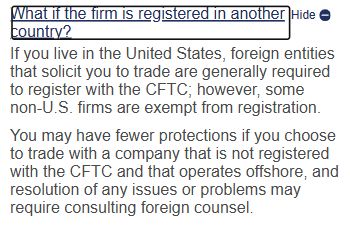
Ask the firm to identify its US registration and relevant activity, or the specific exemption or other regulatory basis it relies on. Verify the answer independently. Do not change your stated residence to make an application go through.
A question you can send before opening an account
“I live in the United States and am considering your retail off-exchange forex account. Which legal company would be my counterparty? Please provide its current US registration and forex status, or explain the specific exemption or other regulatory basis you rely on for this offer. Please also send the client agreement and complaint procedure that would apply to me.”
If the explanation remains unclear, hold off on funding while you clarify it with the relevant regulator or a qualified professional. A familiar trading app does not resolve the question. See what MetaTrader 5 does and does not tell you about a broker.
Check 04
Match the agreement, website and payment recipient
Before paying, compare the company in the agreement with the recipient shown in the deposit instructions. Also compare the website and contact details against independently obtained regulatory information.
Copy the contracting company’s legal name.
Copy the recipient’s name and payment role.
Different names? Ask for the documented relationship before paying.
A payment processor may legitimately receive money for the dealer, so a different name is not automatically proof of fraud. It is a reason to ask for a clear explanation of the recipient’s role and how the payment reaches your account. Do not treat a matching name as a guarantee either.
Keep a copy of the instructions and the explanation. Our payment recipient and legal entity checklist covers this step in more detail.
Check 05
Find the complaint route before you need it
Read the agreement’s complaint process, governing law and dispute forum. Identify which body could receive a complaint about the actual account company and this product. A regulator mentioned on a group website may oversee a different entity.
Ask whether the route covers a US resident and what eligibility conditions apply. Reporting a concern, bringing a claim and obtaining compensation are different outcomes. No tool or regulator link can promise recovery.
The CFTC warns that resolving problems with an unregistered offshore company may require foreign counsel. For the routes to check, use our US forex broker complaint guide or Complaint Route Finder.
Keep one evidence sheet for the proposed account
Save the documents and official record links together. Put a date beside each check so you can repeat it if the broker changes your account company or sends new payment instructions.
| Evidence | Where to check | Still needs an answer |
|---|---|---|
| Legal company + agreement version | Proposed client agreement | Is this the company offering your account? |
| Current US status + forex scope | NFA BASIC and relevant federal regulator | Does the record cover the activity offered? |
| Written US eligibility explanation | Firm’s reply + cited official basis | Does it address your residence and product? |
| Recipient + relationship to dealer | Deposit instructions + written explanation | How would your payment reach your account? |
| Complaint body + conditions | Agreement + body’s own rules | Would it handle your dispute? |
Start with the company name
Use Broker Entity Lookup to organise the available entity evidence, then follow the official record links. If a crucial detail is missing, mark it unresolved rather than guessing.
Sources and review scope
FXPEDIA360 reviewed the linked CFTC, NFA and eCFR sources on 3 October 2026. The eCFR page showed Title 17 as current through 1 October 2026. The NFA search image was captured on 2 October; the CFTC images on 3 October. These show official interfaces and guidance, not a verification of an individual broker.
This article explains a document-checking workflow. We did not open a broker account or test a deposit. Requirements and records can change, so check the live sources for your proposed account. This is general educational information, not individual legal or investment advice.