

Source review: Checked on 14 August 2026 against current FCA, CFTC, ESMA and ASIC investor information. Fee structures vary by broker, account, product, jurisdiction and holding period; always verify the broker’s own legal documents and product schedule.
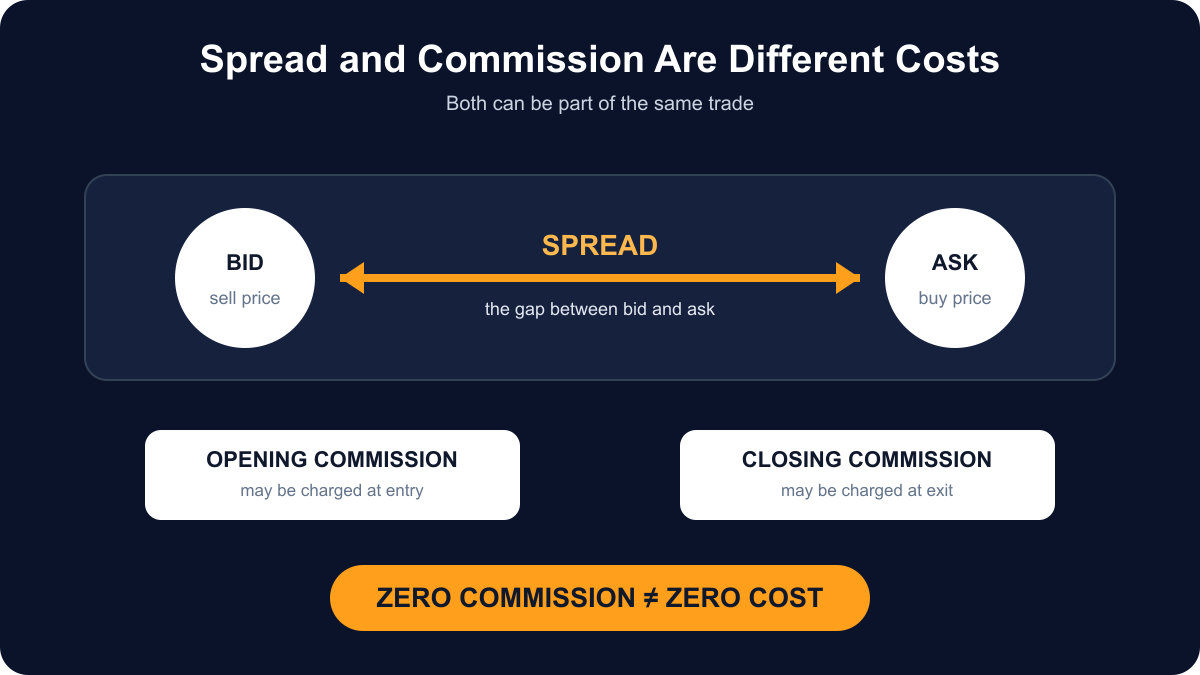
Quick answer: A “zero commission” forex account is not necessarily a zero-cost account. Your all-in cost can include the spread, opening and closing commissions, overnight funding, currency conversion, payment charges, account fees and the difference between the price you expected and the price at which your order was executed.
New traders often compare brokers using one headline number. That is understandable—but it can hide the cost that matters: what a complete, realistic trade actually costs from funding the account to closing the position and withdrawing money.
Why “zero commission” can be misleading
A broker may charge no separate commission and still earn from a wider bid–ask spread. Another may advertise a narrow spread but add a commission at entry and exit. A position held overnight may also attract a daily financing adjustment. None of these structures is automatically good or bad; the important question is whether the full method is disclosed and suitable for the way you plan to trade.
The FCA’s 2025 review of CFD providers examined spread pricing, commissions and overnight funding together. It found that some overnight charges were potentially significant and were not always explained clearly enough. The practical lesson is simple: compare the complete cost structure, not one promotional label.
What counts as the all-in trading cost?
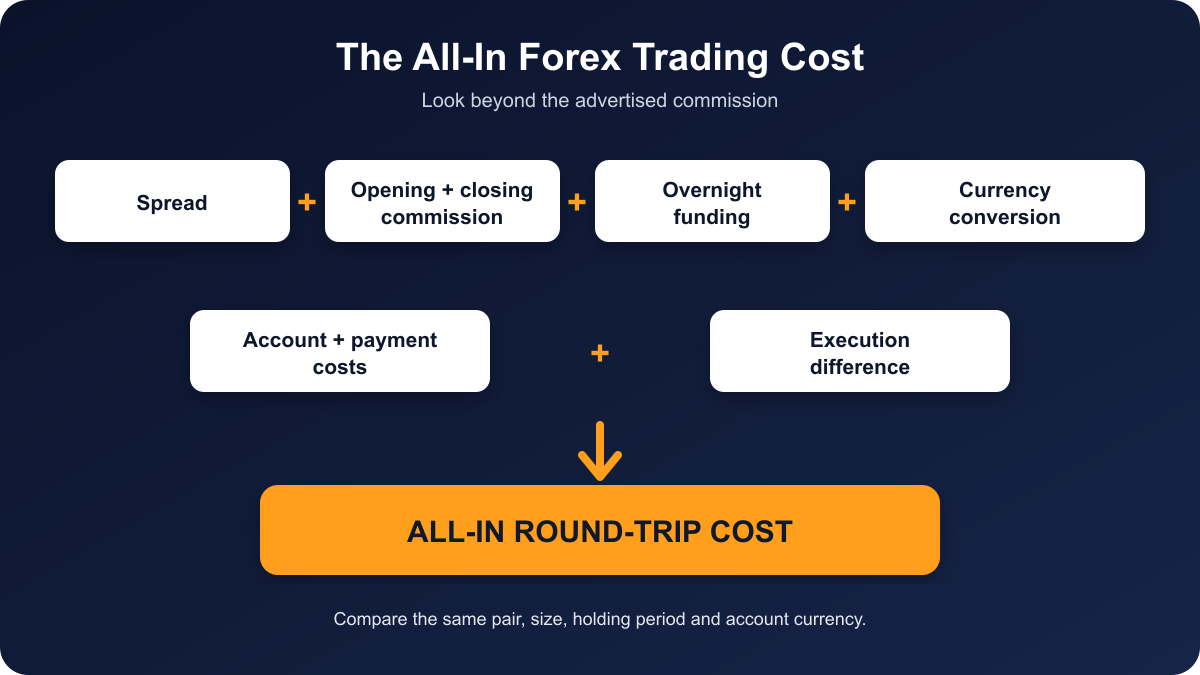
For a useful comparison, think in terms of a round trip: opening a position, holding it for a realistic period and closing it. A practical framework is:
All-in round-trip cost = spread + opening commission + closing commission + funding + conversion + payment/account costs + execution difference
Some items will not apply to every account or every trade. Taxes are also jurisdiction-specific and should not automatically be described as a broker fee. The point of the framework is to force every possible layer into the open before you compare two offers.
10 forex broker costs new traders often miss
1. The bid–ask spread
The spread is the gap between the broker’s buy and sell prices. It creates an immediate cost when a position opens. Spreads may be fixed or variable and can widen during volatile markets, around major news or when liquidity is thinner. A quoted “from” spread is not the same as the spread you will receive at every moment.
What to verify: whether the spread is fixed or variable, typical rather than minimum spreads, and how the broker reports historical or live spread information.
2. Opening and closing commissions
Commission-based accounts can charge per side, per lot or by notional value. “$X commission” is incomplete unless the document says whether it applies once or at both entry and exit. Convert the full round-trip commission into your account currency before comparing it with a spread-only account.
What to verify: the unit, position-size basis, account type and whether the displayed amount is per side or round trip.
3. Overnight funding, rollover or swap
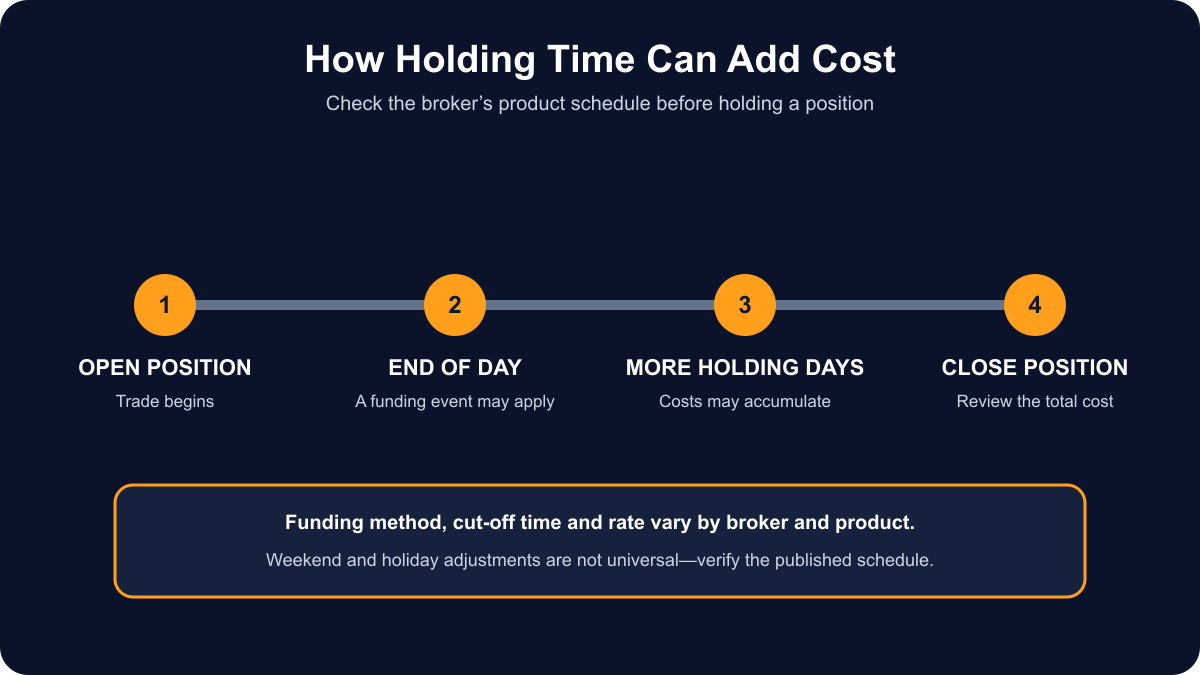
A leveraged position kept open past a broker’s daily cut-off may receive a financing debit or credit. The calculation can depend on the instrument, direction, notional exposure, benchmark rate, broker markup and number of holding days. A small-looking daily amount can become material when a position remains open.
Do not assume that a “swap-free” label means every holding cost disappears. Check eligibility, grace periods, administration charges and the exact products covered.
4. Weekend and holiday funding adjustments
Some providers apply a multi-day adjustment on a particular weekday to account for settlement over weekends or holidays. The timing and amount are product-specific. The phrase “triple swap Wednesday,” for example, should never be treated as a universal rule across all brokers and instruments.
What to verify: the broker’s current rollover calendar, product specification and time zone.
5. Currency conversion charges
If your account base currency differs from the instrument’s settlement currency, deposits, withdrawals, realised profit or loss, commissions or funding may be converted. The cost can appear as a stated percentage, a markup in the exchange rate or both.
What to verify: when conversion occurs, which rate is used, the markup and whether you can choose a more suitable account currency.
6. Deposit, withdrawal and payment-provider costs
A broker may waive its own fee while a bank, card issuer, wallet provider or correspondent bank charges separately. Minimum withdrawal amounts and currency conversion can also change the real cost. Read the broker’s withdrawal policy before depositing, then compare it with our guide to forex broker withdrawal red flags.
A demand to pay a new “tax,” “release,” “insurance” or “verification” fee before funds can be withdrawn is not a normal cost-comparison problem—it is a serious warning sign. The CFTC specifically warns investors not to send additional money merely to recover or withdraw funds.
7. Inactivity, dormancy and account administration fees
An account that is not used for a defined period may incur recurring charges. The clock, fee frequency, balance treatment and reactivation process differ between providers. This matters especially if you plan to trade infrequently or keep a small balance.
What to verify: the inactivity period, amount, frequency, notification process and what happens when the balance reaches zero.
8. Platform, market-data, VPS and add-on charges
The basic platform may be free while premium data, third-party tools, virtual private servers, copy-trading services or specialist order features cost extra. Some fees are waived only after a volume or balance threshold is met.
What to verify: whether the service is optional, the renewal cycle, cancellation method and the conditions for any waiver.
9. Guaranteed stop or special-order premiums
Where offered, a guaranteed stop may have a premium, wider distance requirement or special refund rule. Other order types can have product-specific conditions. Availability and treatment vary significantly by broker and jurisdiction, so do not copy assumptions from another platform.
What to verify: when the premium is charged, whether it is refunded if the stop is not triggered and any minimum-distance rule.
10. Slippage and execution difference
Slippage is not always a published fee. It is the difference between an expected price and the price at which an order is filled. It can be positive or negative and may occur when the market moves or available liquidity changes. Because it affects realised trading cost, it belongs in your comparison even though it is not a line item on a fee table.
What to verify: the broker’s execution policy, order types, rejection or requote practices, and any execution-quality data it publishes.
How leverage changes the impact of fees
Margin is only the amount required to open a leveraged position; it is not necessarily the amount used to calculate every cost. Spreads, commissions and financing can relate to the larger notional exposure. This means a charge that looks small beside the full position can be meaningful beside the cash placed as margin. Both ESMA and ASIC warn that leverage and financing costs can magnify adverse outcomes.
Before funding an account, write down the notional position size, required margin and every cost basis separately. If you cannot reproduce the broker’s example with a calculator, treat that as a question to resolve—not as a detail to ignore.
How to compare two forex brokers fairly
- Verify the legal entity first. A fee schedule is useful only when it belongs to the entity that will hold your account. Follow our broker legal-entity verification process.
- Use one realistic scenario. Keep the same pair, position size, direction, account currency and holding period.
- Calculate a complete round trip. Include entry, holding and exit—not only the advertised opening cost.
- Separate broker and third-party charges. Record bank, card, wallet and conversion costs in their own column.
- Save the evidence. Keep the fee page URL, document version, screenshot or PDF and the date checked.
- Test with a demo where possible. Compare displayed prices and order behaviour without assuming demo execution will perfectly match live conditions.
Also read the broker agreement clauses that deserve extra attention. Fee pages, product specifications, execution policies and client agreements should tell a consistent story.
The FXPEDIA360 fee-check result
PASS: The legal entity is identified, the current fee documents are accessible, and you can reproduce the all-in cost for a realistic trade.
WARNING: Key amounts depend on unclear “from” pricing, variable markups or conditions that you have not yet confirmed.
FAIL: The entity or documents do not match, mandatory charges are hidden, or additional money is demanded to release a withdrawal.
“Pass” does not mean that a broker is guaranteed safe or that trading is suitable for you. It means only that the stated evidence checks were completed without the listed warning or failure condition.
Forex broker fee checklist
- Have I confirmed the exact contracting legal entity?
- Do I know the typical spread—not only the advertised minimum?
- Is commission quoted per side, per lot or round trip?
- Can I reproduce the overnight-funding calculation?
- Have I checked weekend and holiday adjustments?
- Will currency conversion apply to deposits, trades or withdrawals?
- Could my payment provider add a separate charge?
- Are there inactivity, platform, data or add-on fees?
- Have I read the execution policy and withdrawal terms?
- Did I save the source URL and date checked?
Frequently asked questions
Is a zero-commission forex broker cheaper?
Not necessarily. A broker may recover costs through the spread, funding, conversion or other charges. Compare an all-in round-trip scenario rather than the commission label alone.
Are overnight forex fees always charged?
No. Treatment depends on the product, direction, account type, broker and holding period. A credit may apply in some cases, while other cases create a debit. Verify the current product schedule.
Is slippage a broker fee?
Usually it is better described as an execution outcome rather than a published fee. It still changes the realised cost of a trade and should be monitored separately.
What is the biggest fee warning sign?
An undisclosed charge is a concern; a demand for more money before a withdrawal can be released is a stronger red flag. Stop, preserve the communications and verify the entity independently.
Official sources
- FCA: CFD providers’ provision of price and value
- CFTC: Eight things you should know before trading forex
- CFTC: Beware of fee scams targeting workers sidelined by COVID-19
- ESMA: Additional information on CFD product-intervention measures
- ASIC: CFD-sector review and investor refunds
Educational information only. This article is not investment, legal, tax or personalised financial advice. Forex and CFD trading involves substantial risk, and losses can exceed your expectations. Verify every broker, document and cost directly with the relevant provider and regulator.
Continue with the complete Broker Safety guide collection.
Fee evidence table
| Evidence to record | Where to verify it | Why it matters |
|---|---|---|
| Spread and commission | Product specification and fee schedule | Separates headline pricing from total trading cost |
| Financing or swap | Instrument specification | Costs can differ by symbol, direction and holding period |
| Withdrawal, conversion and inactivity fees | Client agreement and payment pages | These charges may sit outside the trading ticket |
Continue the cost audit
Fees should be checked alongside the broker’s execution, slippage and requote terms and the client-agreement clauses that affect your money.